

Buildings and building elements consolidation and repair Buildings and building elements consolidation and repair
Buildings and building
Buildings and building
elements consolidation
and repair
tehnologii de injectare cu rasini
Civil constructions:
Buildings consolidation and bearing capacity increase is achieved by using micropiles technology for foundations and two-component polyurethane resins injection into cracks in structures.
Damage to buildings often occurs as a result of uneven ground subsidence.
Foundation voids occur as a result of groundwater circulation, which washes away the fine part of the soil.
These problems can be remedied by the following methods:
– Execution of micropiles that increase the bearing capacity of the foundation
– Polyurethane resin injection to fill the voids
– Repair of crack/cracks in walls
Foundation reinforcement with micropiles
Micropiles can be used both in the foundations of new buildings erected in complicated geological conditions, and also for the remediation/consolidation of existing buildings foundations.
In the execution of micropiles consolidation works, self-drilling rods are used and polyurethane resin is injected under pressure.
The advantages of using this technology:
– fast installation (no prior drilling is required, R-type self-drilling rods are inserted directly into the ground, at the desired depth, and the injection is done directly through the micropile rod).
– fast hardening of the resin (the micropile can be loaded after 24 hours).
– mobile and light drilling equipment, capable of entering confined spaces (cellars, etc.).
Civil constructions:
Buildings consolidation and bearing capacity increase is achieved by using micropiles technology for foundations and two-component polyurethane resins injection into cracks in structures.
Damage to buildings often occurs as a result of uneven ground subsidence.
Foundation voids occur as a result of groundwater circulation, which washes away the fine part of the soil.
These problems can be remedied by the following methods:
– Execution of micropiles that increase the bearing capacity of the foundation
– Polyurethane resin injection to fill the voids
– Repair of crack/cracks in walls
Foundation reinforcement with micropiles
Micropiles can be used both in the foundations of new buildings erected in complicated geological conditions, and also for the remediation/consolidation of existing buildings foundations.
In the execution of micropiles consolidation works, self-drilling rods are used and polyurethane resin is injected under pressure.
The advantages of using this technology:
– fast installation (no prior drilling is required, R-type self-drilling rods are inserted directly into the ground, at the desired depth, and the injection is done directly through the micropile rod).
– fast hardening of the resin (the micropile can be loaded after 24 hours).
– mobile and light drilling equipment, capable of entering confined spaces (cellars, etc.).
Industrial constructions:
Foundations of machines and equipment.
When modernizing the technological flow, in many cases, old equipment was replaced with new, heavier one. The consolidation of the foundation and the increase in the bearing capacity was done using micropiles and injections in the GEOPUR® system.
In the case of long-term use of large-sized equipment, voids may form under the foundations, as a result of long-term mechanical vibrations and/or the groundwater circulation, which washes away the soil fine fraction. This will generate equipment destabilization.
These types of problems are most often solved by means of special injection technologies, represented by the combination of the micropiles method and independent injections to fill the technological voids.
Foundations consolidating with micropiles is also recommended for newly installed equipment.
The advantages of using this technology:
– fast installation (no prior drilling is required, R-type self-drilling rods are inserted directly into the ground, at the desired depth, and the injection is done directly through the micropile rod).
– fast hardening of the resin (the micropile can be loaded after 24 hours).
– mobile and light drilling equipment, capable of entering confined spaces (cellars, etc.).
Industrial constructions:
Foundations of machines and equipment.
When modernizing the technological flow, in many cases, old equipment was replaced with new, heavier one. The consolidation of the foundation and the increase in the bearing capacity was done using micropiles and injections in the GEOPUR® system.
In the case of long-term use of large-sized equipment, voids may form under the foundations, as a result of long-term mechanical vibrations and/or the groundwater circulation, which washes away the soil fine fraction. This will generate equipment destabilization.
These types of problems are most often solved by means of special injection technologies, represented by the combination of the micropiles method and independent injections to fill the technological voids.
Foundations consolidating with micropiles is also recommended for newly installed equipment.
The advantages of using this technology:
– fast installation (no prior drilling is required, R-type self-drilling rods are inserted directly into the ground, at the desired depth, and the injection is done directly through the micropile rod).
– fast hardening of the resin (the micropile can be loaded after 24 hours).
– mobile and light drilling equipment, capable of entering confined spaces (cellars, etc.).
Historical monuments
Polyurethane resin injection is a minimally invasive technique increasingly used in the consolidation of historical monuments, offering a number of advantages over traditional methods.
Polyurethane resins are polymers that, once injected, expand and fill the gaps, cracks and cavities in the monument’s structure.
The material is injected through small holes, carefully made to minimize the impact on the original appearance of the monument.
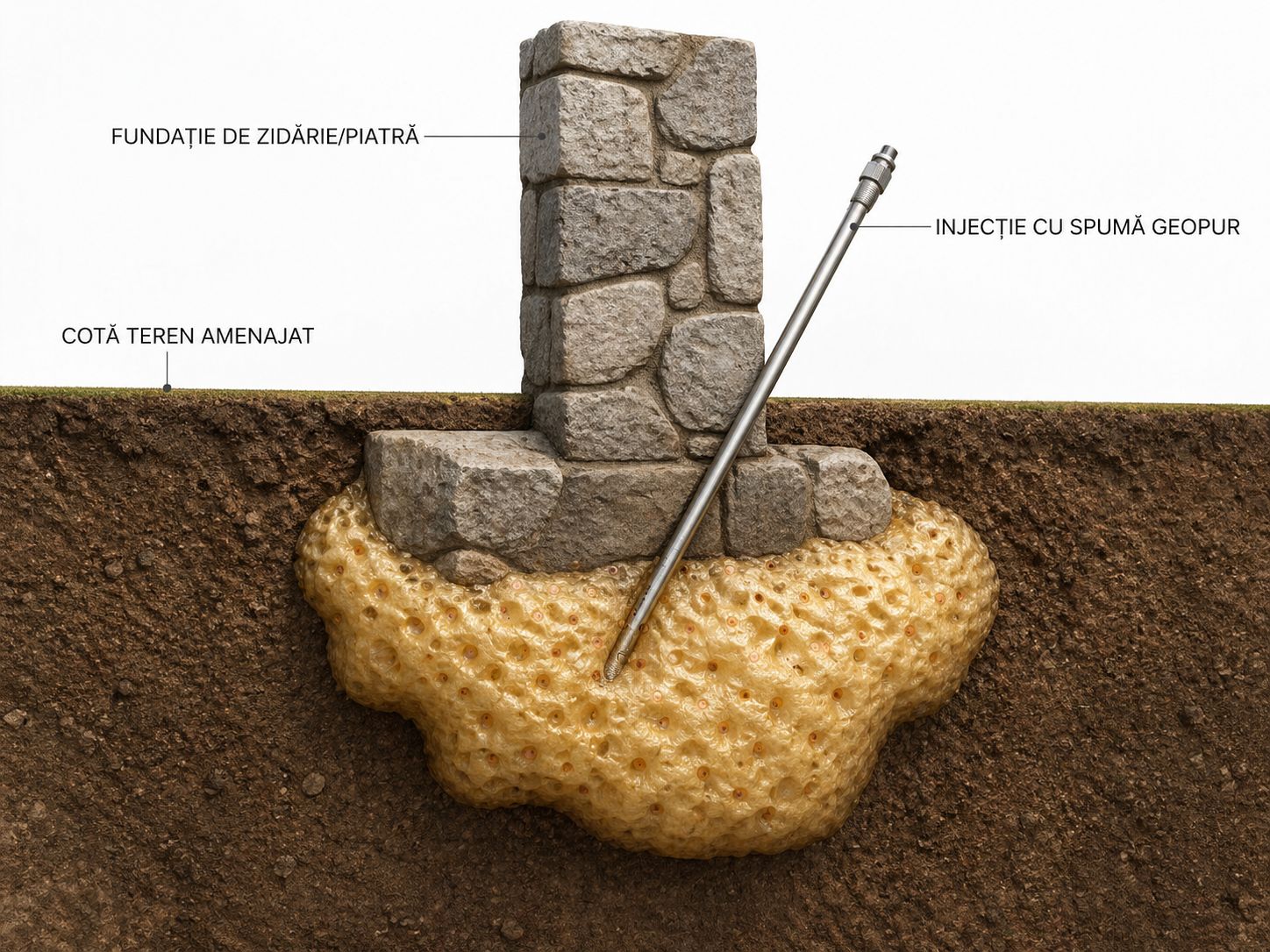
The polyurethane foam, by expanding, consolidates the structure, stabilizing the foundation soil and filling the gaps in the masonry.
The advantages of using this technology:
- Minimally invasive: Significantly reduces the need for major interventions on the structure of the monument, thus preserving its historical appearance.
- Adaptability: Polyurethane foam adapts to various shapes and sizes of gaps, ensuring uniform consolidation.
- Process control: Injection is done under control, allowing the amount of injected material to be adjusted according to needs.
- Durability: Polyurethane foam is resistant to water and degradation, ensuring long-term consolidation.
- Short execution time: Compared to traditional methods, polyurethane foam injection is performed in a shorter time.
- Rapid stabilization of treated areas: The stability of historical buildings/monuments is achieved in a short time for the treated areas, because the injected bicomponent resin reaches its maximum load capacity in 24 hours, compared to 28 days in the case of concrete.
- Archaeological discharge: Depending on the situation, an advantage is that there is no need for archaeological discharge of the site because we don’t need open excavation in order to perform substructure or consolidation works on the foundation ground.
Specific applications for consolidating historical monuments:
- Foundation consolidation: Stabilization of the foundation soil and filling of voids under and in existing foundations.
- Masonry consolidation: Filling of cracks and voids in masonry, restoring the connection between structural elements.
- Protection against water infiltration: Polyurethane foam creates an impermeable barrier, protecting the monument from the destructive effects of water.
Design Sketch:
Historical monuments
Polyurethane resin injection is a minimally invasive technique increasingly used in the consolidation of historical monuments, offering a number of advantages over traditional methods.
Polyurethane resins are polymers that, once injected, expand and fill the gaps, cracks and cavities in the monument’s structure.
The material is injected through small holes, carefully made to minimize the impact on the original appearance of the monument.
The polyurethane foam, by expanding, consolidates the structure, stabilizing the foundation soil and filling the gaps in the masonry.
The advantages of using this technology:
- Minimally invasive: Significantly reduces the need for major interventions on the structure of the monument, thus preserving its historical appearance.
- Adaptability: Polyurethane foam adapts to various shapes and sizes of gaps, ensuring uniform consolidation.
- Process control: Injection is done under control, allowing the amount of injected material to be adjusted according to needs.
- Durability: Polyurethane foam is resistant to water and degradation, ensuring long-term consolidation.
- Short execution time: Compared to traditional methods, polyurethane foam injection is performed in a shorter time.
- Rapid stabilization of treated areas: The stability of historical buildings/monuments is achieved in a short time for the treated areas, because the injected bicomponent resin reaches its maximum load capacity in 24 hours, compared to 28 days in the case of concrete.
- Archaeological discharge: Depending on the situation, an advantage is that there is no need for archaeological discharge of the site because we don’t need open excavation in order to perform substructure or consolidation works on the foundation ground.
Specific applications for consolidating historical monuments:
- Foundation consolidation: Stabilization of the foundation soil and filling of voids under and in existing foundations.
- Masonry consolidation: Filling of cracks and voids in masonry, restoring the connection between structural elements.
- Protection against water infiltration: Polyurethane foam creates an impermeable barrier, protecting the monument from the destructive effects of water.